Today, August 30, 2011, I start a new job and a big adventure. Of course, I've slept less than a wink and there are endless cups of tea in my future, but I am raring to go. Wish me luck!
Love,
MissWhistle
Tuesday, August 30, 2011


Saturday, August 27, 2011
The spotted double axil


Wherein the greater spotted -- inspired by Frances Bacon -- demonstrates her 360s.
HUNGRY: SANDWICH
"If this doesn't make the blog, I'll be very upset" says Matti, with a half-grin that tells me he's deadly serious.
We are sitting around a large dining room table, filled with candles and flowers and wine for a Friday Shabbat dinner. There is pasta with corn and tomatoes, grilled vegetables with burrata, two kinds of challah (pretzel and chocolate chip, both indescribably delicious) and children and parents from my daughter's school. We are celebrating two seniors' last Friday night in Los Angeles before they fly to Wesleyan and Tufts. I am the honorary shiksa, and Matti takes great pains to describe why the eating of the bread is similar to communion.
Matti, a crazy branding genius (overuse of the word genius annoys me too, but in this case it would be a mistake not to call a spade a spade) believes very strongly in the words of Deuteronomy; that it is not just society's duty but our own to give to those less fortunate than ourselves. He takes this very seriously but believes that it is a point of honor to ensure that everyone who is given money does something for that money.
A very nice man at the table (who, incidentally grew up in the town of Weed, California -- a popular tourist destination with the Humboldt County crowd) recalled how a homeless man in Century City had told him such a good story and pulled so hard on the strings of his heart, that he had given him a twenty dollar bill. The next day, walking with a group of colleagues, he encountered the man again, who ignored everyone else but focused in on our friend, looking deep into his eyes and telling the exact same story, with the same heart-rending intensity. "I felt like a dolt" he said. "No, you're looking at this incorrectly" said Matti. "You should have said 'I gave you $20 for yesterday's story, because it was a good story, but if you want another $20 you have to tell me another story, a better story."
"You see, I not only give money to the homeless, but I give them marketing advice" he says. "I critique their signs. For example, a man on the Laurel Canyon off-ramp was holding a sign which said 'HUNGRY SANDWICH' and I explained to him that he was doing himself a disservice. If he is hungry he should just state, quite clearly 'HUNGRY'. The SANDWICH part is a distraction. It's confusing. What does it mean? That the sandwich is hungry?" We, of course, laughed. "No, this is serious" he went on. "I've changed his sign twice now, and he tells me that business has gone up 25% since I got involved."
We are sitting around a large dining room table, filled with candles and flowers and wine for a Friday Shabbat dinner. There is pasta with corn and tomatoes, grilled vegetables with burrata, two kinds of challah (pretzel and chocolate chip, both indescribably delicious) and children and parents from my daughter's school. We are celebrating two seniors' last Friday night in Los Angeles before they fly to Wesleyan and Tufts. I am the honorary shiksa, and Matti takes great pains to describe why the eating of the bread is similar to communion.
Matti, a crazy branding genius (overuse of the word genius annoys me too, but in this case it would be a mistake not to call a spade a spade) believes very strongly in the words of Deuteronomy; that it is not just society's duty but our own to give to those less fortunate than ourselves. He takes this very seriously but believes that it is a point of honor to ensure that everyone who is given money does something for that money.
A very nice man at the table (who, incidentally grew up in the town of Weed, California -- a popular tourist destination with the Humboldt County crowd) recalled how a homeless man in Century City had told him such a good story and pulled so hard on the strings of his heart, that he had given him a twenty dollar bill. The next day, walking with a group of colleagues, he encountered the man again, who ignored everyone else but focused in on our friend, looking deep into his eyes and telling the exact same story, with the same heart-rending intensity. "I felt like a dolt" he said. "No, you're looking at this incorrectly" said Matti. "You should have said 'I gave you $20 for yesterday's story, because it was a good story, but if you want another $20 you have to tell me another story, a better story."
"You see, I not only give money to the homeless, but I give them marketing advice" he says. "I critique their signs. For example, a man on the Laurel Canyon off-ramp was holding a sign which said 'HUNGRY SANDWICH' and I explained to him that he was doing himself a disservice. If he is hungry he should just state, quite clearly 'HUNGRY'. The SANDWICH part is a distraction. It's confusing. What does it mean? That the sandwich is hungry?" We, of course, laughed. "No, this is serious" he went on. "I've changed his sign twice now, and he tells me that business has gone up 25% since I got involved."
A cake for those who love madeleines
Here is Wendy's recipe for almond torte: "one of those cakes we who love madeleines, would love":
Almond Torte
NB: let the cake cool before removing it from pan
1 1/4 cups sugar
7/8 cup (about 8 oz) soft almond paste
(This recipe, from Chez Panisse Desserts is a favorite of S. Irene Virbila in the Los Angeles Times.)
 |
| image courtesy of Los Angeles Times |
Almond Torte
NB: let the cake cool before removing it from pan
1 1/4 cups sugar
7/8 cup (about 8 oz) soft almond paste
1 1/4 cups softened unsalted butter
1 tsp vanilla extract
6 eggs (room temperature)
1 cup flour
1 1/2 tsp baking powder
1/4 tsp salt
Beat sugar with almond paste until almond paste is in fine pieces or better, pulverize it in food processor.
Beat in butter and vanilla.
Then cream the mixture until it is light and fluffy.
Beat in whole eggs, one at a time, beating well after each addition so the eggs are thoroughly mixed.
Mix the flour, baking powder and salt, and beat until just thoroughly blended.
Butter and flour and paper a 9 inch springform pan and turn batter into it smoothing the top evenly.
Bake in preheated 325 degree oven for 1 to 1 1/4hours or until toothpick comes out clean.
1 tsp vanilla extract
6 eggs (room temperature)
1 cup flour
1 1/2 tsp baking powder
1/4 tsp salt
Beat sugar with almond paste until almond paste is in fine pieces or better, pulverize it in food processor.
Beat in butter and vanilla.
Then cream the mixture until it is light and fluffy.
Beat in whole eggs, one at a time, beating well after each addition so the eggs are thoroughly mixed.
Mix the flour, baking powder and salt, and beat until just thoroughly blended.
Butter and flour and paper a 9 inch springform pan and turn batter into it smoothing the top evenly.
Bake in preheated 325 degree oven for 1 to 1 1/4hours or until toothpick comes out clean.
Serves 12. Serve with creme anglaise or sliced peaches.
Friday, August 26, 2011
A Summer Day
With the crickets & grasshoppers chirruping loudly in the canyon on this otherwise still, hot summer night, I am reminded of this wonderful poem by Mary Oliver, re-posted from July 18, 2010:
Who made the world?
Who made the swan, and the black bear?
Who made the grasshopper?
This grasshopper, I mean-
the one who has flung herself out of the grass,
the one who is eating sugar out of my hand,
who is moving her jaws back and forth instead of up and down-
who is gazing around with her enormous and complicated eyes.
Now she lifts her pale forearms and thoroughly washes her face.
Now she snaps her wings open, and floats away.
I don't know exactly what a prayer is.
I do know how to pay attention, how to fall down
into the grass, how to kneel down in the grass,
how to be idle and blessed, how to stroll through the fields,
which is what I have been doing all day.
Tell me, what else should I have done?
Doesn't everything die at last, and too soon?
Tell me, what is it you plan to do
with your one wild and precious life?
-- Mary Oliver
Who made the world?
Who made the swan, and the black bear?
Who made the grasshopper?
This grasshopper, I mean-
the one who has flung herself out of the grass,
the one who is eating sugar out of my hand,
who is moving her jaws back and forth instead of up and down-
who is gazing around with her enormous and complicated eyes.
Now she lifts her pale forearms and thoroughly washes her face.
Now she snaps her wings open, and floats away.
I don't know exactly what a prayer is.
I do know how to pay attention, how to fall down
into the grass, how to kneel down in the grass,
how to be idle and blessed, how to stroll through the fields,
which is what I have been doing all day.
Tell me, what else should I have done?
Doesn't everything die at last, and too soon?
Tell me, what is it you plan to do
with your one wild and precious life?
-- Mary Oliver
Thursday, August 25, 2011
Thank you, Grasshopper
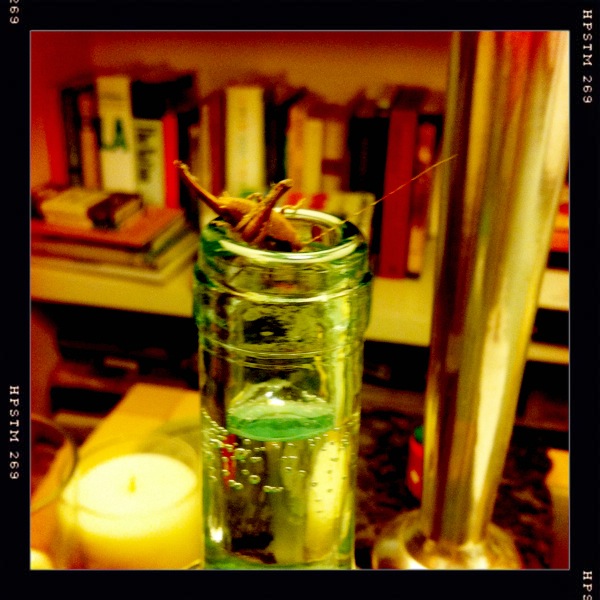

Twice in three days a grasshopper has landed near me, and stayed. Once while having dinner with some girlfriends he appeared on the back of my chair and didn't want to leave, and tonight he's sitting in the mouth of my water bottle on my bedside table. Apparently "A grasshopper's appearance indicates a time in which we will experience great leaps of happiness. It teaches us to trust our inner voice and to act upon it." It is the Chinese symbol of good luck and abundance.
This might be the time to express my enormous gratitude for all the good wishes. I am deeply appreciative.
Tuesday, August 23, 2011
sugar in water: Mary Karr
This is excerpted from an interview with Mary Karr in the Winter 2009 issue of The Paris Review:
INTERVIEWER
Do you have any writing rituals, things you have to do in order to write?KARR
I pray. I ask God what to write. I know that sounds insane, but I do. I say: What do you want me to say? I have a sense that God wanted these books written. That doesn’t mean they’re meant to be bestsellers. Nor am I hearing voices. But a lot of times I’ll get stuck and I’ll just say, Help me. A nonbeliever might think of it as talking to my superego, or some better self. But I do have a sense of being guided.INTERVIEWER
What does it sound like when you get stuck?KARR
Fuck. Shit. Don’t. Fuck. You dumb bitch—who ever told you that you could write? That’s what it sounds like.INTERVIEWER
When did you start praying?KARR
When I got sober, in 1989—twenty years ago now. Only with prayer could I stop drinking for more than a day or two. Once I made three months clean, but it was a white-knuckled horror show. Call it self-hypnosis, prayer, whatever. To skeptics I say, Just try it. Pray every day for thirty days. See if your life gets better. If it doesn’t, tell me I’m an asshole. People tend to judge a faith’s value based on its dogma, which ignores religion in practice. It’s like believing if you watch enough porn or read enough gynecology books, you’ll know about pussy. For me, being a Catholic is a set of activities. Certain dogma seems nuts to me too. I’m not the Pope’s favorite Catholic.INTERVIEWER
Do you pray before you write, or during?KARR
Both. I try to pray formally morning and night starting with breathing exercises or centering prayer. Then the Lord’s Prayer or the Prayer of St. Francis: “Lord, make me an instrument of your peace...” Sometimes I listen to the daily liturgy on my iPod from Pray-As-You-Go.com, or I go online at Sacred Space—both Jesuit sites. I say thank you a lot. This morning I walked out saying, Thank you for the wind, thank you for the blue sky. Really dumb, puerile stuff. At night I do what Jesuits call an examen of conscience, plus I keep a list of people to pray for.Sunday, August 21, 2011
A birthday party in Santa Monica


My friend Andrea makes birthday parties extra special. She laid a table in her garden, thrust a mojito-like cocktail in everyone's hand as they arrived, scattered bright pink dahlias and orange kumquats around the table, and cooked a feast from Ottolenghi's Plenty. There were chicken skewers (marinated in orange zest and sumac) with dates, baked fennel with lemon and goat cheese, mini eggplant rolls, sweet corn salad, figs & arugula. In lieu of birthday cake we had coconut mini cakes and foil-wrapped red velvet raspberry ding dongs, one of which
I secreted home in my dress pocket. The dog, lying decorously on chaise, is Kiwi.
Happy birthday Alison!
Artichoke fricassee
My friend Lucy, she of household pet pig fame, is one of my favorite, fearless cooks. Obsessed as she is with her Big Green Egg barbecue and smoker, last night's dinner comprised homemade pizzas (made on the Egg) and marinated double lamb chops, which are my very favorite thing and were made for me, I know, because she's worried I'm not eating enough (I've lost about 15 pounds in the last 8 weeks and I swan around gazing in the mirror at my new sylph-like figure and shrunken cavity of a stomach -- it's called the stress diet apparently). Determined to feed me, as a mother would, she created a feast. One of the highlights was this extraordinarily delicious yet slightly fiddly artichoke fricassee from Greek chef Michael Psilakis:
# 8 medium artichokes, long stems left on, if present
# 2 lemons
# 2 tablespoons extra-virgin olive oil
# 2 large Spanish or sweet onions, thickly sliced
# 2 bulbs fennel, thickly sliced crosswise
# 2 cups white wine
# 2 quarts water
# 2 fresh bay leaves or 4 dried leaves
# Kosher salt and cracked black pepper
# 2 tablespoons garlic purée
# Generous handful small, picked sprigs dill
# 4 ounces (1 stick) cold, unsalted butter, cut into pieces
directions
Pull off the tough artichoke leaves until you reach the pale yellow leaves.
Lucy says: I got scared about the hairy part and so I took off all the leaves. (That's what she said!)
Cut off the pointed tops about half an inch above the base. Trim the dark bits from the stem and base with a vegetable peeler. As you work, throw the trimmed artichokes into a bowl of cold water acidulated with the juice of 1 lemon.
In a large, heavy pot or Dutch oven, warm the olive oil over medium heat. Add the onion and fennel, and sauté until slightly wilted, about 5 to 7 minutes. Deglaze the pan with the white wine and simmer briskly until completely evaporated. Add the drained artichokes, water, bay leaves, 1 tablespoon kosher salt, and a generous grinding of pepper. Bring to a boil. Reduce the heat, partially cover the pan, and simmer until the artichokes are soft and offer almost no resistance to the point of a knife, about 35 minutes.
Drain the artichokes and vegetables, reserving all the braising liquid (discard the bay leaves). Let cool for 10 minutes. Pour 2 cups of the braising liquid into a blender and add three quarters of the fennel and onion pieces (reserve the remaining vegetables and the artichokes). Purée until completely smooth. (Reserve the remaining braising liquid for another use.) Return the puréed liquid to the pan; simmer very actively over high heat to reduce and thicken the juices, 10 to 15 minutes.
Stir in the Garlic Purée, the juice of the remaining lemon, and the dill. Return the artichokes and remaining vegetables to the pan. Reduce to a simmer and swirl in the butter until melted. Remove from the heat.
-- Courtesy Michael Psilakis and GMA
 |
| picture courtesy GMA |
# 8 medium artichokes, long stems left on, if present
# 2 lemons
# 2 tablespoons extra-virgin olive oil
# 2 large Spanish or sweet onions, thickly sliced
# 2 bulbs fennel, thickly sliced crosswise
# 2 cups white wine
# 2 quarts water
# 2 fresh bay leaves or 4 dried leaves
# Kosher salt and cracked black pepper
# 2 tablespoons garlic purée
# Generous handful small, picked sprigs dill
# 4 ounces (1 stick) cold, unsalted butter, cut into pieces
directions
Pull off the tough artichoke leaves until you reach the pale yellow leaves.
Lucy says: I got scared about the hairy part and so I took off all the leaves. (That's what she said!)
Cut off the pointed tops about half an inch above the base. Trim the dark bits from the stem and base with a vegetable peeler. As you work, throw the trimmed artichokes into a bowl of cold water acidulated with the juice of 1 lemon.
In a large, heavy pot or Dutch oven, warm the olive oil over medium heat. Add the onion and fennel, and sauté until slightly wilted, about 5 to 7 minutes. Deglaze the pan with the white wine and simmer briskly until completely evaporated. Add the drained artichokes, water, bay leaves, 1 tablespoon kosher salt, and a generous grinding of pepper. Bring to a boil. Reduce the heat, partially cover the pan, and simmer until the artichokes are soft and offer almost no resistance to the point of a knife, about 35 minutes.
Drain the artichokes and vegetables, reserving all the braising liquid (discard the bay leaves). Let cool for 10 minutes. Pour 2 cups of the braising liquid into a blender and add three quarters of the fennel and onion pieces (reserve the remaining vegetables and the artichokes). Purée until completely smooth. (Reserve the remaining braising liquid for another use.) Return the puréed liquid to the pan; simmer very actively over high heat to reduce and thicken the juices, 10 to 15 minutes.
Stir in the Garlic Purée, the juice of the remaining lemon, and the dill. Return the artichokes and remaining vegetables to the pan. Reduce to a simmer and swirl in the butter until melted. Remove from the heat.
-- Courtesy Michael Psilakis and GMA
Saturday, August 20, 2011
Some Trees

These are amazing: each
Joining a neighbor, as though speech
Were a still performance.
Arranging by chance
To meet as far this morning
From the world as agreeing
With it, you and I
Are suddenly what the trees try
To tell us we are:
That their merely being there
Means something; that soon
We may touch, love, explain.
And glad not to have invented
Some comeliness, we are surrounded:
A silence already filled with noises,
A canvas on which emerges
A chorus of smiles, a winter morning.
Place in a puzzling light, and moving,
Our days put on such reticence
These accents seem their own defense.
-- John Ashbery
Friday, August 19, 2011
watermelon, tomato, mint

I'd like to give Rachel credit for this salad, but she says it's Lila's recipe so she can't take credit, but it was her idea to put homegrown yellow tomatoes (still warm from the sun) into the mix. I don't want to quibble. Watermelon salads have long been summer fair -- when the sun is warm and the shade is elusive and fruit is cheap. This could be a lunch on its own or an accompaniment to a summer supper.
Cold watermelon, cubed
Vine-ripened tomatoes, roughly chopped
Feta cheese, cut into small squares
Avocado, chopped
Mint, chopped
Balsamic vinaigrette (incorporated good quality white and brown balsamic vinegar, a little garlic, a little blue agave nectar for sweetness, olive oil, salt and pepper)
Combine the ingredients in a large bowl and serve.
Exquisitely delicious.
paradox
“I have found the paradox, that if you love until it hurts, there can be no more hurt, only more love.”
-- Mother Theresa
-- Mother Theresa
Tuesday, August 16, 2011
Don't just do something; stand there
A most excellent article on creativity from the Los Angeles Times: Don't just do something; stand there
"Creative work needs solitude," writes the poet Mary Oliver. "It needs the whole sky to fly in, and no eye watching till it comes to that certainty which it aspires to.... Privacy, then. A place apart — to pace, chew pencils, to scribble and erase and scribble again."
Sunday, August 14, 2011
Pork buns from Star Noodle

There's a ridiculously good restaurant on Maui -- Lahaina's Star Noodle, which sits up on the mountain over looking the town. I'm afraid we went there three times (and would have gone more had we not restrained ourselves); once after arriving at the airport, once for dinner and once on the way home. Imagine something like London's Wagamama or New York's Momofuku on a smaller scale -- a deliciously modern, light space, filled with knowledgeable, kind people (props to Justin and Zane) and some of the best Asian food we've ever tasted. The menu ranges from ramen to local saiman (local noodles with spam, fish cake and green onion in a delicious broth) to Vietnamese pancakes to spicy pickled vegetables (namasu) to yuzu sorbet to tiny donuts on sticks (malasadas) with three dipping sauces. But the highlight of this very reasonably priced restaurant was the steamed pork buns.
 |
| image courtesy Star Noodle |
The buns are two bites of soft bao-like bread stuffed with sweet roast belly pork, cucumber, a few green onions and hoisin sauce, served with hoisin and spiced Chinese mustard. Visit Star Noodle here.
Saturday, August 13, 2011
Last day on Maui
And so we come, the children & I, to our last day on Maui, home of old spirits, warm seas, guava jam, miraculous birds, soft ukelele music and the kindest people I've ever encountered.
"...place heals the hurt, soothes the outrage, fills the terrible vacuum that human beings can make." —Eudora Welty (h/t WVD)


Campbell
"It is by going down into the abyss that we recover the treasures of life. Where you stumble, there lies your treasure." -- Joseph Campbell
Friday, August 12, 2011


Tuesday, August 09, 2011


Sunday, August 07, 2011
You do not cross into it whistling
"If you live in the dark a long time and the sun comes out, you do not cross into it whistling. There's an initial uprush of relief at first, then-for me, anyway- a profound dislocation. My old assumptions about how the world works are buried, yet my new ones aren't yet operational.There's been a death of sorts, but without a few days in hell, no resurrection is possible."
-- Mary Karr, from Lit: A memoir
Self-portrait with ring

I am particularly enamored of my iPhone's photographic capabilities (Hipstamatic, Instagram, Camerabag) hence the somewhat self-indulgent, melancholy Cindy Sherman-inspired shot.
Meanwhile, it is pleasantly misty and grey at 7am in the canyon. Have a very happy Sunday wherever you are in the world.
I am an optimist. It does not seem too much use being anything else. -- Winston Churchill
Saturday, August 06, 2011

The Round
Light splashed this morning
on the shell-pink anemones
swaying on their tall stems;
down blue-spiked veronica
light flowed in rivulets
over the humps of the honeybees;
this morning I saw light kiss
the silk of the roses
in their second flowering,
my late bloomers
flushed with their brandy.
A curious gladness shook me.
So I have shut the doors of my house,
so I have trudged downstairs to my cell,
so I am sitting in semi-dark
hunched over my desk
with nothing for a view
to tempt me
but a bloated compost heap,
steamy old stinkpile,
under my window;
and I pick my notebook up
and I start to read aloud
and still-wet words I scribbled
on the blotted page:
"Light splashed..."
I can scarcely wait till tomorrow
when a new life begins for me,
as it does each day,
as it does each day.
on the shell-pink anemones
swaying on their tall stems;
down blue-spiked veronica
light flowed in rivulets
over the humps of the honeybees;
this morning I saw light kiss
the silk of the roses
in their second flowering,
my late bloomers
flushed with their brandy.
A curious gladness shook me.
So I have shut the doors of my house,
so I have trudged downstairs to my cell,
so I am sitting in semi-dark
hunched over my desk
with nothing for a view
to tempt me
but a bloated compost heap,
steamy old stinkpile,
under my window;
and I pick my notebook up
and I start to read aloud
and still-wet words I scribbled
on the blotted page:
"Light splashed..."
I can scarcely wait till tomorrow
when a new life begins for me,
as it does each day,
as it does each day.
-- Stanley Kunitz (via Writer's Almanac)
Thursday, August 04, 2011
Homesick
When we love, when we tell ourselves we do,
we are pining for first love, somewhen,
before we thought of wanting it. When we rearrange
the rooms we end up living in, we are looking
for first light, the arrangement of light,
that time, before we knew to call it light.
Or talk of music, when we say
we cannot talk of it, but play again
C major, A flat minor, we are straining
for first sound, what we heard once,
then, in lost chords, wordless languages.
What country do we come from? This one?
The one where the sun burns
when we have night? The one
the moon chills; elsewhere, possible?
Why is our love imperfect,
music only echo of itself,
the light wrong?
We scratch in dust with sticks,
dying of homesickness
for when, where, what.
-- Carol Ann Duffy, from New Selected Poems 1984-2004
we are pining for first love, somewhen,
before we thought of wanting it. When we rearrange
the rooms we end up living in, we are looking
for first light, the arrangement of light,
that time, before we knew to call it light.
Or talk of music, when we say
we cannot talk of it, but play again
C major, A flat minor, we are straining
for first sound, what we heard once,
then, in lost chords, wordless languages.
What country do we come from? This one?
The one where the sun burns
when we have night? The one
the moon chills; elsewhere, possible?
Why is our love imperfect,
music only echo of itself,
the light wrong?
We scratch in dust with sticks,
dying of homesickness
for when, where, what.
-- Carol Ann Duffy, from New Selected Poems 1984-2004
Tuesday, August 02, 2011

Monday, August 01, 2011

From Letters to a Young Poet: Rilke on Love
This is long, but rather insightful:
People have (with the help of conventions) oriented all their solutions toward the easy and toward the easiest side of the easy; but it is clear that we must hold to what is difficult; everything alive holds to it, everything in Nature grows and defends itself in its own way and is characteristically and spontaneously itself, seeks at all costs to be so and against all opposition. We know little, but that we must hold to what is difficult is a certainty that will not forsake us; it is good to be solitary, for solitude is difficult; that something is difficult must be a reason the more for us to do it.
To love is good, too: love being difficult. For one human being to love another: that is perhaps the most difficult of all out tasks, the ultimate, the last test and proof, the work for which all other work is but preparation. For this reason young people, who are beginners in everything, cannot yet know love: they have to learn it. With their whole being, with all their forces, gathered close about their lonely, timid, upward-beating heart, they must learn to love. But learning - time is always a long, secluded time, and so loving, for a long while ahead and far into life, is - solitude, intensified and deepened loneness for him who loves. Love is at first not anything that means merging, giving over and uniting with another (for what would a union be of something unclarified and unfinished, still subordinate?), it is a high inducement to the individual to ripen, to become world, to become world for himself for another's sake, it is a great exacting claim upon him, something that chooses him out and calls him to vast things. Only in this sense, as the task of working at themselves ("to hearken and to hammer day and night"), might young people use the love that is given them. Merging and surrendering and every kind of communion is not for them (who must save and gather for along, long time still), is the ultimate, is perhaps that for which human lives as yet scarcely suffice.
Whoever looks seriously at it finds that neither for death, which is difficult, no for difficult love has any explanation, any solution, any hint of way yet been discerned; and for these two problems that we carry wrapped up and hand on without opening, it will not be possible to discover any general rule resting in agreement. But in the same measure in which we begin as individuals to put life to the test, we shall, being individuals, meet these great things at closer range. The demands which the difficult work of love makes upon our development are more than life-size, and as beginners we are not up to them. But if we nevertheless hold out and take this love upon us as burden and apprenticeship, instead of losing ourselves in all the light and frivolous play, behind which people have hidden from the most earnest earnestness of their existence - then a little progress and alleviation will perhaps be perceptible to those who come long after us; that would be much.
-- Rainer Maria Rilke
People have (with the help of conventions) oriented all their solutions toward the easy and toward the easiest side of the easy; but it is clear that we must hold to what is difficult; everything alive holds to it, everything in Nature grows and defends itself in its own way and is characteristically and spontaneously itself, seeks at all costs to be so and against all opposition. We know little, but that we must hold to what is difficult is a certainty that will not forsake us; it is good to be solitary, for solitude is difficult; that something is difficult must be a reason the more for us to do it.
To love is good, too: love being difficult. For one human being to love another: that is perhaps the most difficult of all out tasks, the ultimate, the last test and proof, the work for which all other work is but preparation. For this reason young people, who are beginners in everything, cannot yet know love: they have to learn it. With their whole being, with all their forces, gathered close about their lonely, timid, upward-beating heart, they must learn to love. But learning - time is always a long, secluded time, and so loving, for a long while ahead and far into life, is - solitude, intensified and deepened loneness for him who loves. Love is at first not anything that means merging, giving over and uniting with another (for what would a union be of something unclarified and unfinished, still subordinate?), it is a high inducement to the individual to ripen, to become world, to become world for himself for another's sake, it is a great exacting claim upon him, something that chooses him out and calls him to vast things. Only in this sense, as the task of working at themselves ("to hearken and to hammer day and night"), might young people use the love that is given them. Merging and surrendering and every kind of communion is not for them (who must save and gather for along, long time still), is the ultimate, is perhaps that for which human lives as yet scarcely suffice.
Whoever looks seriously at it finds that neither for death, which is difficult, no for difficult love has any explanation, any solution, any hint of way yet been discerned; and for these two problems that we carry wrapped up and hand on without opening, it will not be possible to discover any general rule resting in agreement. But in the same measure in which we begin as individuals to put life to the test, we shall, being individuals, meet these great things at closer range. The demands which the difficult work of love makes upon our development are more than life-size, and as beginners we are not up to them. But if we nevertheless hold out and take this love upon us as burden and apprenticeship, instead of losing ourselves in all the light and frivolous play, behind which people have hidden from the most earnest earnestness of their existence - then a little progress and alleviation will perhaps be perceptible to those who come long after us; that would be much.
-- Rainer Maria Rilke
if seventy were young
if seventy were young
and death uncommon
(forgiving not divine,
to err inhuman)
or any thine a mine
--dingdong:dongding--
to say would be to sing

if broken hearts were whole
and cowards heroes
(the popular the wise,
a weed a tearose)
and every minus plus
--fare ill:fare well--
a frown would be a smile

if sorrowful were gay
(today tomorrow,
doubting believing and
to lend to borrow)
or any foe a friend
--cry nay:cry yea--
november would be may

that you and i'd be quite
--come such perfection--
another i and you,
is a deduction
which(be it false or true)
disposes me to shoot
dogooding folk on sight
-- e.e. cummings
Subscribe to:
Posts (Atom)